


Why choosing the right lens is crucial
Eyeglasses are far more than a fashion accessory – they are a medical device that significantly impacts visual acuity. Anyone buying new glasses will sooner or later face the question: Are standard lenses sufficient, or is it worth investing in premium lenses?
The answer depends on several factors: the individual’s visual impairment, their daily routine, and, last but not least, their requirements for comfort and visual acuity. This article explains clearly and concisely what the terms „standard“ and „premium“ mean – and what really matters when making your decision.
What are standard glasses?
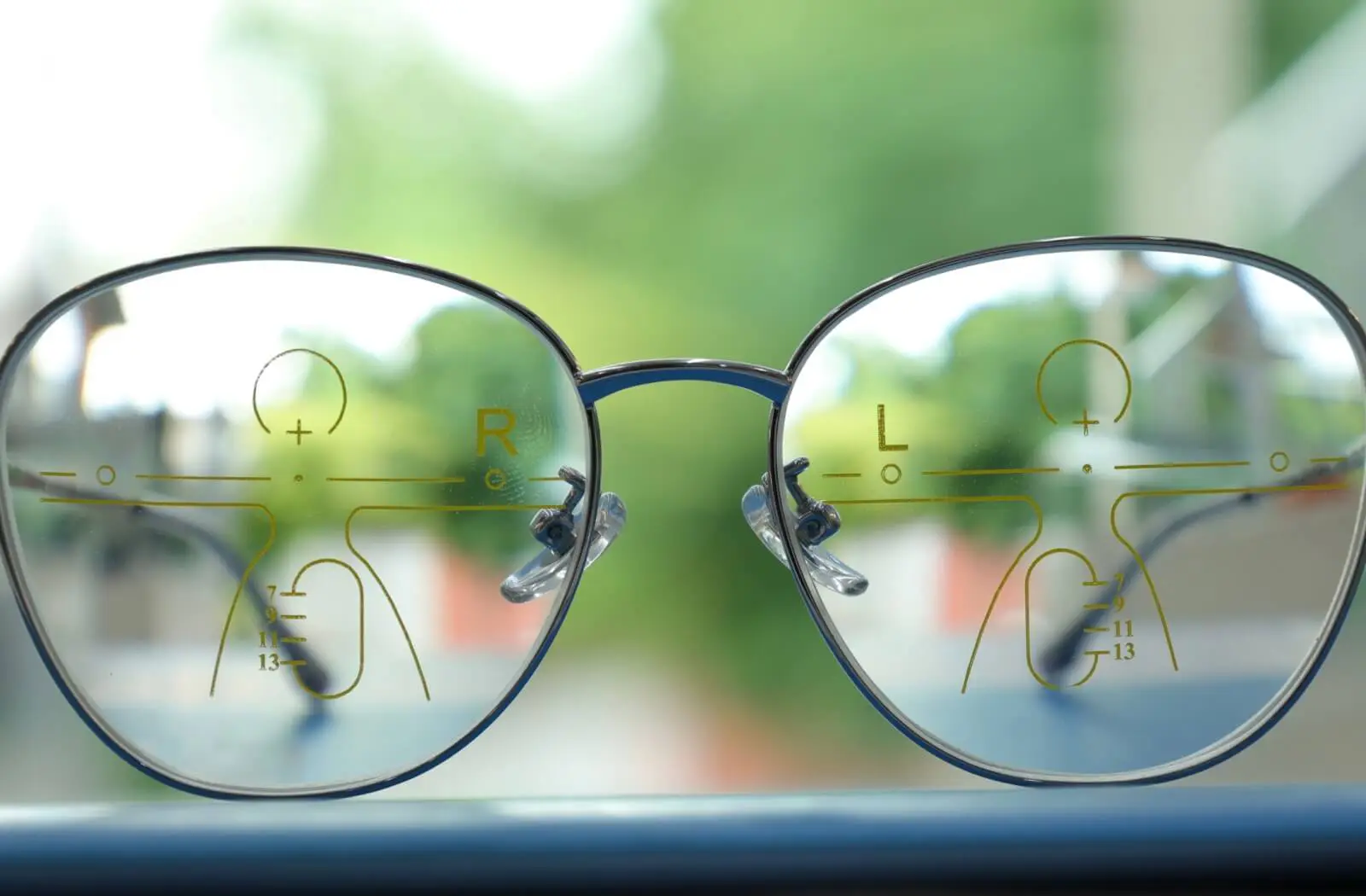
Standard lenses – also known as basic lenses or entry-level lenses – are manufactured using a simplified, standardized process. They are based on predefined grinding curves and design parameters intended for a wide range of refractive errors.
Features of standard lenses:
- Spherical or simple aspherical design: The optical correction area is calculated less individually. Peripheral aberrations (edge blurring) increase more with spherical lenses.
- Standardized manufacturing parameters: The glass thickness, base curvature and optical center are calculated according to general standards, not according to the individual parameters of the substrate.
- Limited anti-reflective quality: Cheaper anti-reflective coatings reduce reflections, but do not achieve the performance of high-quality multi-layer anti-reflective coatings.
- Reduced individual customization: Parameters such as corneal vertex distance, pantoscopic tilt angle or frame tilt are not taken into account in the lens calculation.
Recommended article: Which lenses are suitable for working at a computer screen?
Who are standard glasses suitable for?
Standard lenses can be a sensible choice for:
- Individuals with low refractive error (usually below ±2.0 diopters, with or without low astigmatism)
- Children and adolescents who require „frequent changes in strength“.
- Spare or second pairs of glasses that are only worn occasionally
The advantages of premium lenses
Premium lenses, also known as custom lenses or freeform lenses , are individually calculated and manufactured for the customer using state-of-the-art production technologies. This process precisely takes into account the anatomy of the eye and the chosen frame.
Our recommended products:
The three main pillars of premium technology:
A. Freeform technology (Freeform)
While standard lenses are ground on the front surface, freeform technology allows for precise processing of the entire lens surface. This results in significantly larger fields of vision and a massive reduction in edge distortion – a crucial advantage, especially for progressive lenses.
B. Individualization (biometrics)
A premium lens takes into account the wearer’s personal parameters . These include:
- The distance between the eyes (pupillary distance)
- The frame shape and its fit on the face
- Vertex distance (distance between the eye and the spectacle lens )
- The wearer’s viewing habits (e.g., focus on computer work or sports)
C. Higher-value compensation
Premium lenses are almost without exception equipped with high-end finishes :
- Superior anti-reflective coating: Almost 99% of the light is transmitted, eliminating the “ghost image effect” during night driving.
- Hard coating: Increased scratch resistance.
- Lotus effect: Dirt- and water-repellent surfaces make cleaning considerably easier.
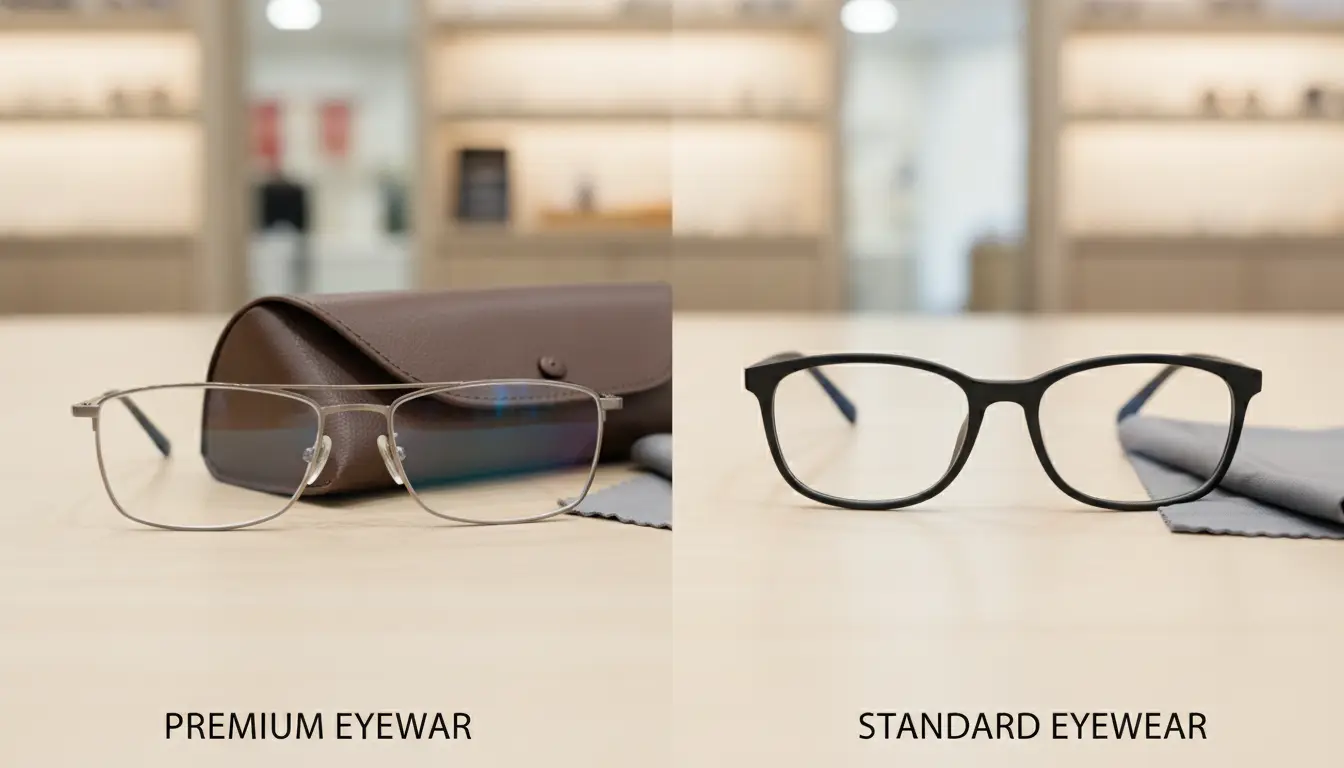
Direct comparison: Standard vs. Premium
| criterion | Standard glass | Premium glass |
|---|---|---|
| field of vision | Limited, edges often blurry | Maximum size, edge-to-edge sharpness |
| Manufacturing process | Mass production (standard curves) | Individual freeform calculation |
| Adjustment | Hardly personalized, if at all | Fully matched to eyes and frame |
| Acclimatization | May take longer | Very fast through natural representation |
| Weight & Thickness | Rather thicker and heavier | Optimized, thinner and lighter |
| Refinement | Basic anti-reflective coating | High-end finishing (cleaning, protection) |
Why the difference is particularly noticeable with progressive lenses
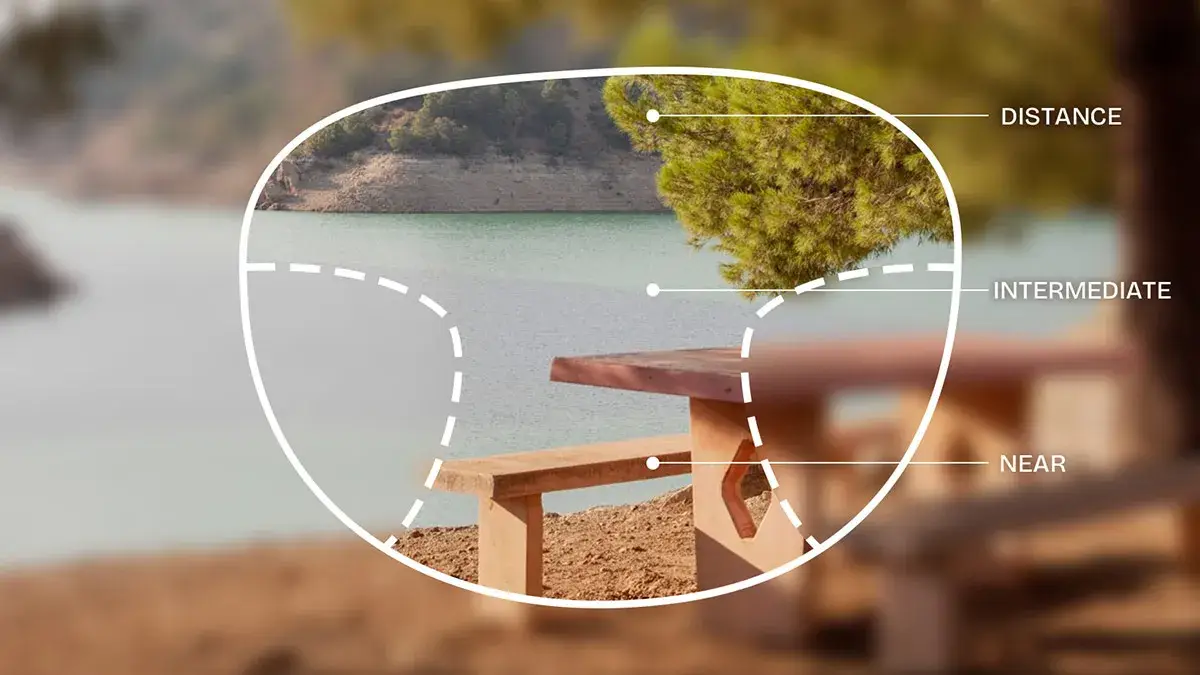
Especially with progressive lenses, the difference between standard and premium is striking. A standard progressive lens often has narrow corridors for intermediate vision. The wearer has to move their head frequently to see clearly. A premium progressive lens, on the other hand, offers a dynamic field of vision . The transition between distance, intermediate, and near vision is optimized so that the eye can look through the lens comfortably without having to move the head significantly to focus.
Frequently Asked Questions
Is the extra cost for premium lenses really worth it?
In most cases, yes. Especially with higher diopter values or astigmatism (corneal curvature), premium lenses offer a significantly higher quality of life thanks to a larger and sharper field of vision. If you wear your glasses for many hours every day, the increased comfort of premium lenses is worth the extra cost.
Can I see faster with premium lenses than with standard lenses?
Yes. Because premium lenses are calculated based on eye movement and the anatomical features of your face, they minimize adjustment difficulties. The brain and eyes typically adapt to the new lens design much faster.
Are thinner lenses always premium lenses?
Not necessarily. Thin lenses (higher refractive index) are a material property. They can also be chosen for standard lenses to improve aesthetics. Premium lenses, however, go further: they combine thinner material with a superior optical design.
How can I tell if a glass is high quality?
Don’t just focus on the price. A good optician will explain the design to you (e.g., „freeform“ or „individual“). High-quality lenses are also usually recognizable by their excellent anti-reflective coating (no color reflections such as green or blue in side lighting).
Which type of glass is right for your eyes?
Choosing the right lenses is as individual as your fingerprint. A standard approach rarely leads to the best result. At Gilga Optik GmbH in Burgebrach, we take the time to analyze your specific vision habits, your anatomy, and your lifestyle to find the optimal lenses for you.
We offer transparent advice – without hidden costs and with a focus on your personal visual comfort.
📍 Gilga Optik GmbH · Burgebrach
📞 Book your eye exam appointment now
🗓️ Please make an appointment in advance so that we can take the necessary time.
This article is for general information purposes only and does not replace a medical diagnosis or individual optometric consultation.
